# You swapped the motor and kept the shaft
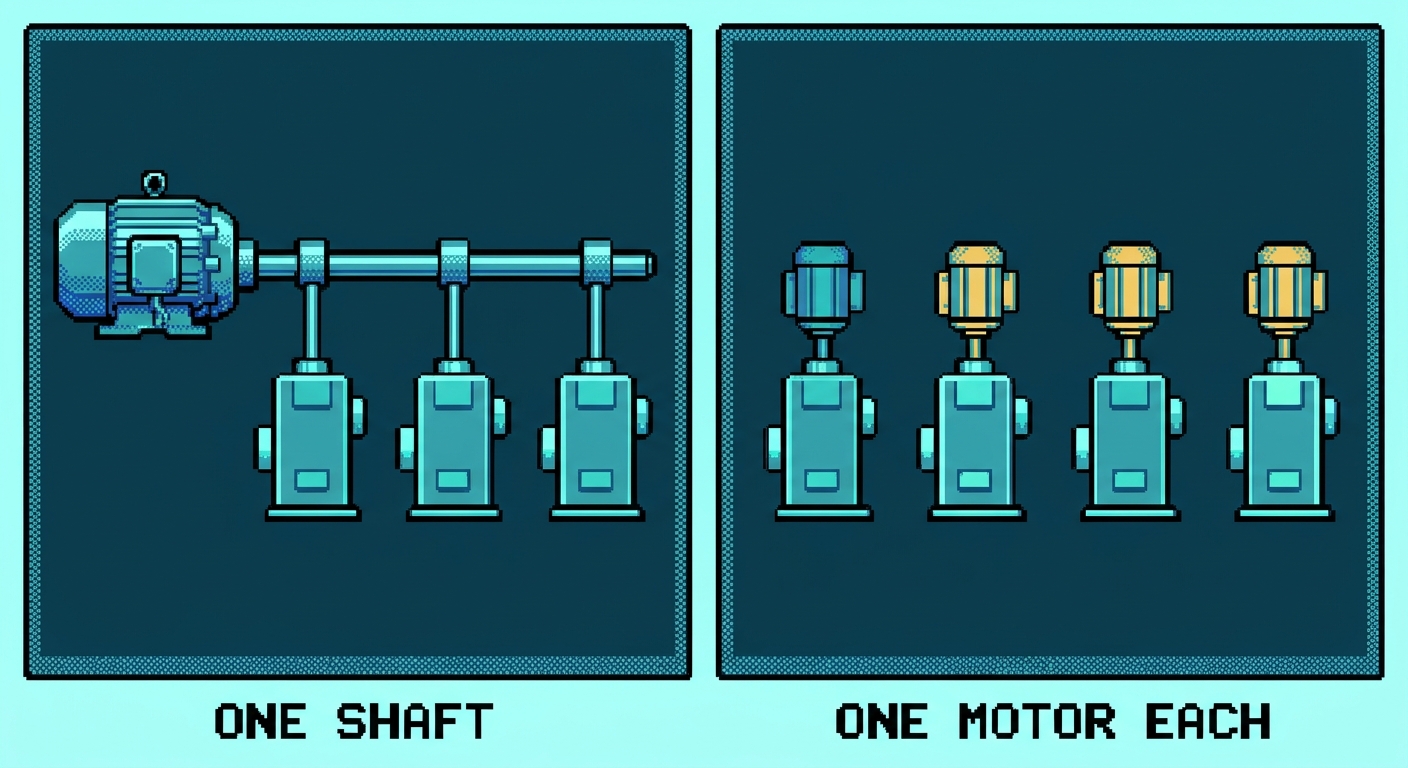
The first generation of electric factories looked exactly like the steam ones. Same building, same long central shaft running the length of the ceiling, same belts dropping down to the same machines in the same rows. The only thing that changed was what turned the shaft. Cheaper power, same factory.
Paul David’s point about electrification is that the first thirty years looked like this. The payoff came later, when someone realised a motor can be small, and every machine can have its own, and then you don’t need the shaft at all. No shaft means the machines can go anywhere, which means you can put them in the order of the work instead of in the order of the power, all on one floor, with cranes and daylight. Productivity doubled, decades after the technology that made it possible.
I keep coming back to this because it’s the most honest description I know of what’s happening with coding agents inside most teams.
The shaft is still there
Adopting an agent today usually means the same ticket, the same branch, the same pull request, the same review, the same standup. Faster typing attached to the same factory. That’s not nothing — you get a cheaper basement. But the shape of the work didn’t change, so the shape of the result didn’t either.
You can see it in the numbers people are collecting. The amount of code produced with agents went up a lot. The amount of software actually released and used moved barely at all. That gap isn’t a tooling problem, it’s a layout problem. We bolted the new motor onto the old shaft and expected the building to rearrange itself.
What the shaft actually is
In a software team, the shaft is the human carrying context between steps. Someone remembers why that table has a column nobody reads. Someone knows the deploy needs a manual step because of a customer on an old contract. Someone knows which of the three “temporary” services is load bearing.
That transport is what makes the old layout work, and it’s invisible until you remove it. Agents are very good at the machines and terrible at the belts. Give them the task, skip the belt, and you find out what the belt was holding up.
There’s a cheap experiment I like for this: take one recurring deliverable and hand it to an agent with no human context injected at all. No side channel, no “by the way, be careful with X”. Wherever it fails, that failure isn’t a prompt to tune. It’s a piece of knowledge that only exists in someone’s head, or a decision nobody ever actually made. You end up with a map of your org’s undocumented knowledge, drawn to scale, for the price of one afternoon.
Some of those gaps you fix by writing them down. Some you fix by automating the decision away. A few you decide are fine to keep in a head, because they’re cheap to hold and expensive to codify. That last group is the one people forget to be deliberate about.
Review was never the bottleneck either
The second thing that breaks is verification. If agents produce five or ten times the code and your review capacity is the same, you don’t have more software, you have a longer queue. A queue with a nice green checkmark on it.
Reviewing generated code is a different activity from reviewing a colleague’s. With a colleague you can rebuild the intent from the conversation, the ticket, the way they write. With an agent there’s no intent to recover, only behaviour to check. Which means the thing you need isn’t a better reviewer, it’s a set of checks that don’t need you: tests that fail when they should, evals that catch the regression the compiler can’t see, a loop the agent can run on its own before it comes back.
The layout change, in other words, is the feedback loop. That’s the part that has to be rebuilt, and it’s the part that gets skipped because it doesn’t show up in a demo.
What I’d change first
I’d stop measuring output. Lines, commits, pull requests — all of it goes up when the motor gets cheaper, and none of it tells you whether the building works. The number I care about is the one that goes down: how long it takes from “this is needed” to “this is running and someone uses it”.
Then I’d make verification cheaper than review, on purpose. Every hour spent making a check run without me is an hour I don’t spend being the shaft.
And I’d be patient with the shape of it. Those factories took thirty years, and nobody was being stupid during those thirty years. They were running a business.
Have fun!!